Boundaries 101: What They Are, Why They Matter & How to Set Them
What Are Boundaries?
Boundaries are the limits and expectations we set with ourselves and others to protect our emotional, physical, and mental well-being. They define what we are comfortable with, how we want to be treated, and what behavior we will and won’t accept.
Healthy boundaries allow us to:
Maintain our identity
Protect our energy and mental health
Build respectful, balanced relationships
Prevent burnout, resentment, and emotional overload
Healthy boundaries aren’t walls, they are pathways to healthier connection and self-respect.
Types of Personal Boundaries
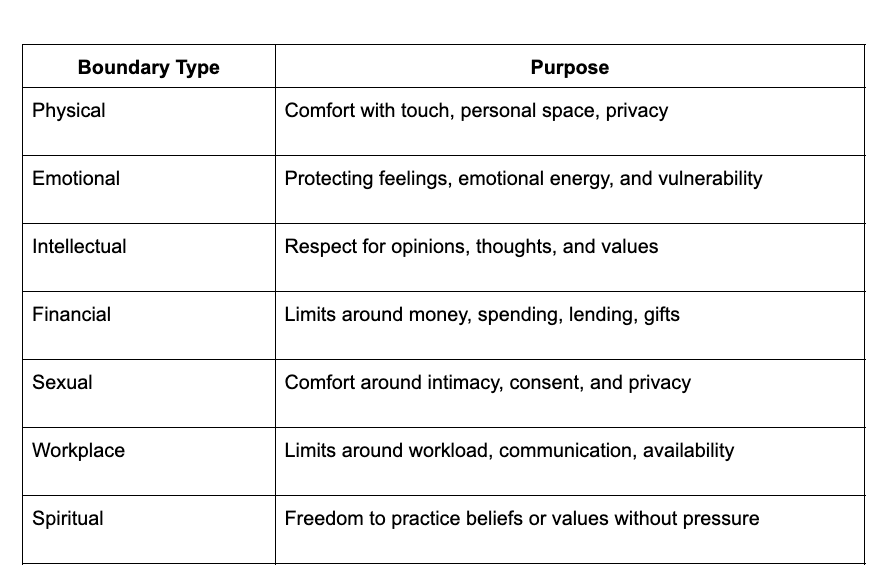
There are many forms of boundaries. Knowing them helps you set the right ones:
Healthy boundaries are a foundation of self-respect, self-care, and healthy relationships.
Why Boundaries Matter
Strong boundaries are essential for mental health and emotional well-being. They help us:
Protect personal well-being
Prevent stress, burnout, resentment, and emotional overload.
Build self-respect
Boundaries say, “I value my time, energy, and feelings.”
Strengthen relationships
Clear limits support honesty, trust, mutual respect, and emotional intimacy.
Support mental health
Setting boundaries reduces anxiety, guilt, obligation-driven decisions, and emotional exhaustion.
Promote independence & growth
Healthy boundaries encourage autonomy and model emotional maturity for others.
Prevent conflict
Clear expectations reduce misunderstandings and resentment.
Prioritize self-care
Boundaries protect time, energy, and rest so you can show up fully for yourself and others.
Signs You May Need Better Boundaries
If these resonate, your boundaries may need strengthening:
Difficulty saying no
Overcommitting or over-giving
People-pleasing behavior
Feeling responsible for others’ emotions
Frequent resentment or irritability
Fear of disappointing others
Feeling guilty for prioritizing yourself
Allowing disrespect or chronic boundary-pushing
Emotional burnout or exhaustion
Needing constant approval or validation
If you constantly feel drained after interacting with someone, a boundary is needed.
How to Start Setting Healthy Boundaries
1. Reflect on your needs & values
Ask yourself:
What do I need more of? (time, rest, privacy, support)
What drains me emotionally or mentally?
Where do I feel resentment or overwhelm?
2. Identify your limits
Notice when something feels:
Uncomfortable
Disrespectful
Manipulative
Emotionally draining
3. Communicate clearly
Use “I” statements:
“I need time to rest, so I won’t be able to help tonight.”
Short, direct, kind.
4. Practice saying no
Start small and build confidence.
A “no” is a full sentence.
5. Be consistent
Inconsistency signals your boundary is flexible, even when it's not.
6. Prioritize self-care
Rest and recharge to maintain your energy and emotional capacity.
7. Set boundaries with yourself, to
Examples:
Limiting screen time
Sticking to a bedtime
Saying no to work after hours
8. Seek support
Therapy, support groups, and healing resources can help you strengthen boundaries with confidence.
Helpful Boundary Reminders
You can't set a boundary and manage someone else's feelings.
Saying yes out of fear, guilt, or obligation = poor boundaries.
Over-explaining gives others room to push back.
If someone gets angry at your boundary, they benefited from your lack of one.
Flexible boundaries are healthy; rigid ones may be necessary with boundary-pushers.
Boundary Script Examples (Sandwich Method)
“Thank you for inviting me. I won’t be able to attend. I hope it’s a wonderful time.”
“I appreciate you asking, but I can’t help tonight. I'm happy to support next weekend.”
“Thanks for thinking of me, but it’s not for me. I hope you enjoy!”
“This weekend won’t work, but I'd love to get together at the end of the month.”
Short. Kind. Firm. No reason needed.
Self-Reflection Questions
Where do I struggle most to set boundaries?
Who is easy to set boundaries with — and who isn’t?
How did my family model boundaries growing up?
Do I respect others’ boundaries the way I expect them to respect mine?
Final Thoughts
If you feel drained, resentful, or overwhelmed in your relationships, boundaries aren’t selfish: They are self-protection and a path to healthier connections.
Boundaries take practice, but every time you set one, you reinforce:
✨ Self-worth
✨ Emotional maturity
✨ Respect for your time and energy
